
A Paradigm Shift in How We Understand Obesity
The medical community’s understanding of obesity has undergone a significant evolution. Where it was once viewed primarily as a lifestyle issue — a comorbidity arising from poor choices — it is now increasingly classified as a chronic, progressive disease in its own right. This is not merely a semantic change. It has profound implications for how patients are assessed, counselled, and treated.
Obesity is now understood to be associated with more than 200 distinct health conditions. More significantly, it is no longer viewed as a consequence of those conditions — it is increasingly recognised as a driver of them. Adipose tissue, long dismissed as passive calorie storage, is now known to function as a highly active endocrine organ, secreting pro-inflammatory cytokines and metabolic mediators that exert systemic effects on the cardiovascular, hepatic, and renal systems.
“Obesity is not simply excess weight — it is a state of chronic biological dysfunction that reshapes the disease trajectory of multiple organ systems simultaneously.“
The Role of Visceral Adiposity
Not all fat is metabolically equivalent. At a healthy weight, the majority of adipose tissue is stored subcutaneously, where it functions as a relatively inert energy reserve. As fat mass increases, the body’s capacity for safe subcutaneous storage becomes overwhelmed, and lipid deposition shifts to visceral compartments — surrounding the liver, kidneys and heart.
Visceral adipose tissue is considerably more metabolically active than its subcutaneous counterpart. It exhibits higher lipolytic activity, generates excess free fatty acids, and produces pro-inflammatory mediators that enter the portal circulation directly. The downstream consequences — hepatic steatosis, insulin resistance, systemic inflammation, and accelerated cardiovascular risk — are well documented.
Genetic studies further suggest that individuals predisposed to visceral rather than subcutaneous fat storage carry a substantially elevated cardiometabolic risk profile, independent of total body weight.
Why Treatment Must Be Matched to the Individual
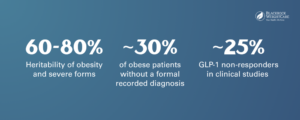
The emergence of GLP-1 receptor agonists has transformed the medical management of obesity, offering clinically meaningful weight reduction and cardiovascular benefit for many patients. However, the evidence is clear that these agents do not work uniformly. Approximately one in four patients with obesity does not achieve clinically significant weight loss with GLP-1 therapy alone — underscoring the heterogeneity of the condition and the need for a stratified treatment approach.
Bariatric surgery remains the most effective and durable intervention available for patients with severe obesity or those with significant metabolic comorbidities. Its benefits extend well beyond weight reduction: improvements in glycaemic control, blood pressure, hepatic steatosis, and cardiovascular risk are well established, and in many cases precede significant weight loss — suggesting mechanisms of action that go beyond caloric restriction alone.
The Diagnosis Gap — and Why Early Referral Matters
A further challenge is the persistent under-diagnosis of obesity in clinical practice. Recent data suggests that approximately 30% of individuals meeting the BMI threshold for obesity do not have a formal obesity diagnosis recorded. Earlier identification creates earlier opportunity — to intervene before comorbidities develop or compound, and to match patients to the treatment pathway most likely to be effective for their individual biology.
Blackrock WeightCare – Specialist Obesity Care in Dublin
Blackrock WeightCare provides comprehensive, evidence-based obesity treatment at the Blackrock Clinic. Our service offers bariatric surgical assessment and intervention, medical obesity management including GLP-1 therapies, and structured multidisciplinary follow-up – with a shared goal of delivering meaningful, sustained improvements in both weight and metabolic health.
For GPs considering referral, or for patients seeking specialist assessment, we welcome enquiries through our website. The right treatment, delivered at the right time, can change the long-term health trajectory of patients living with obesity.
Referring a patient or seeking a specialist consultation? We’d be glad to hear from you – 01 255 2479.
Your Health. We Care.