The Most Important Question I’m Asked
If you are considering weight loss surgery in Ireland, one question comes up in almost every consultation: should I have the sleeve or the bypass?
It is the right question to ask. Both procedures are highly effective, both are proven to produce durable weight loss, and both are available at Blackrock WeightCare using Ireland’s first robotic bariatric surgery programme. But they work differently, suit different patients, and come with different long-term considerations.
There is no universal answer. But there is a best answer for you – and this guide will help you understand what that might be.
How Each Procedure Works
Gastric Sleeve (Sleeve Gastrectomy)
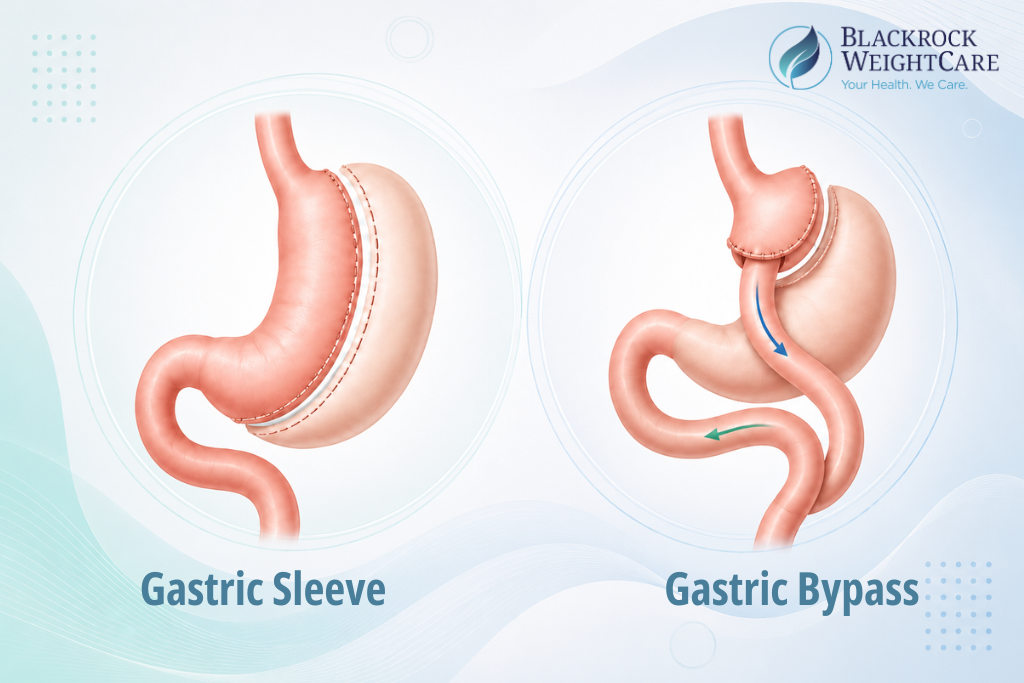
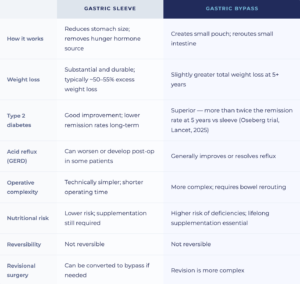
The stomach is permanently reduced to roughly 20% of its original size — forming a narrow, sleeve-shaped tube. This limits how much food you can eat and, critically, removes the portion of the stomach that produces most of the hunger hormone ghrelin. The result is that patients feel full faster and feel less hungry overall. There is no rerouting of the digestive system.
Gastric Bypass (Roux-en-Y Gastric Bypass)
A small stomach pouch is created at the top of the stomach, and the small intestine is rerouted to connect to it directly – bypassing the remainder of the stomach and the upper section of the small bowel. Food passes through a shorter digestive route. This produces powerful changes in gut hormones, and has particularly strong effects on conditions like type 2 diabetes, often producing remission before significant weight loss has even occurred.
How They Compare: The Evidence
Evidence · Lancet Diabetes & Endocrinology, 2025
The Oseberg trial — a long-term randomised controlled trial — found that gastric bypass was superior to sleeve gastrectomy for remission of type 2 diabetes at 5 years, with bypass patients more than twice as likely to achieve remission. Bypass also produced greater total weight loss and better outcomes for LDL cholesterol. The SleeveBypass trial (Lancet Regional Health, 2024) found the two procedures produced clinically comparable excess BMI loss at 5 years, though bypass showed advantages in total weight loss and cholesterol outcomes.
Who Is Each Procedure Best For?
Gastric Sleeve – Gastric Sleeve tends to suit patients who have no significant acid reflux, are looking for a technically simpler procedure, have a lower BMI range for surgery, do not have type 2 diabetes or have well-controlled diabetes, or wish to minimise the risk of nutritional complications.
Gastric Bypass – Gastric Bypass tends to suit patients who have type 2 diabetes or pre-diabetes, have significant acid reflux or GERD, have a higher BMI, have had a sleeve gastrectomy that produced insufficient weight loss, or where maximum metabolic benefit is the primary clinical goal.
It is important to be honest: these are guides, not rules. Individual anatomy, comorbidities, previous surgical history, and personal circumstances all factor into the recommendation. This is precisely why a thorough pre-operative assessment — including consultation with a dietitian, physician, and psychologist — is essential before any decision is made.

What Both Procedures Share
Despite their differences, gastric sleeve and gastric bypass have far more in common than they have apart:
Both procedures: produce substantial, durable weight loss · improve or resolve type 2 diabetes, hypertension, sleep apnoea and high cholesterol · are performed laparoscopically (keyhole surgery) or robotically at Blackrock WeightCare · require lifelong nutritional supplementation and follow-up · have well-established long-term safety profiles · are covered by VHI, Laya Healthcare and Irish Life Health under qualifying plans.
The landmark Swedish Obese Subjects (SOS) study — which followed over 4,000 patients for up to 20 years — found that bariatric surgery was associated with a 23% reduction in overall mortality compared to matched controls receiving usual care, and a 30% reduction in cardiovascular mortality. Surgery adds years to life. Both procedures share in this benefit.
A Note on Robotic Surgery
At Blackrock WeightCare, both sleeve gastrectomy and gastric bypass are available using Ireland’s first robotic bariatric surgery programme. Robotic-assisted surgery allows greater precision, improved visualisation, and can be particularly advantageous for patients with higher BMI or more complex anatomy. Mr Robb will advise at the consultation whether the robotic or laparoscopic technique is most appropriate for your procedure.
Your Health. We Care.