Bariatric surgery remains the most effective long-term treatment for severe obesity and its associated metabolic complications. However, as with any chronic disease intervention, a proportion of patients may require further assessment years after their initial procedure. Revision bariatric surgery is a specialised area of practice, and appropriate referral from primary care plays a central role in optimising patient outcomes.
Mr William Robb, Consultant Bariatric and Upper Gastrointestinal Surgeon at Blackrock WeightCare, has consistently emphasised that revision surgery should not be viewed as failure. Obesity is a chronic, relapsing disease. Surgical intervention is powerful, but long-term disease progression, anatomical factors and evolving metabolic challenges may require reassessment.
Understanding revision bariatric surgery
Revision bariatric surgery refers to a secondary procedure performed after a previous weight loss operation. This may involve:
- Conversion of one procedure to another
- Correction of anatomical complications
- Surgical management of inadequate weight loss or weight regain
- Treatment of severe reflux or nutritional complications
Revision surgery is technically more complex than primary bariatric surgery and should be undertaken in experienced, high-volume centres.
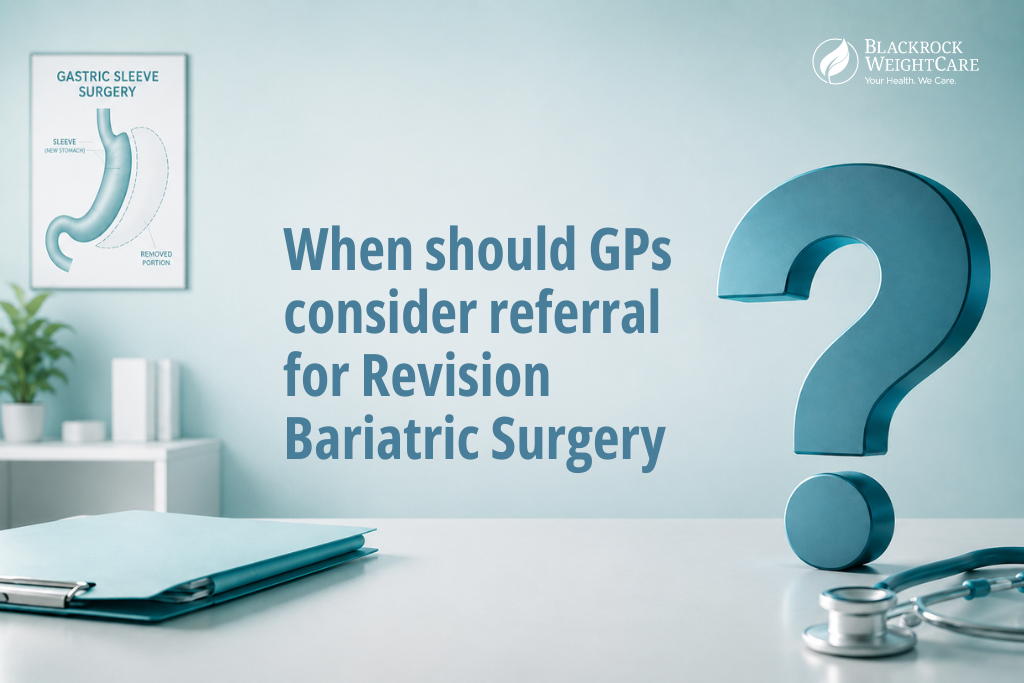
When should GPs consider referral?
There are several clear clinical scenarios where referral for specialist reassessment is appropriate.
1. Significant weight regain
Some degree of weight regain can occur several years after bariatric surgery and does not automatically indicate surgical failure. However, substantial regain — particularly when accompanied by recurrence of comorbidities such as type 2 diabetes, hypertension or obstructive sleep apnoea – warrants specialist review.
In clinical practice, revision referrals most commonly follow sleeve gastrectomy. While sleeve surgery is highly effective for many patients, a subset may experience weight regain over time or develop anatomical changes such as sleeve dilation. In selected cases, conversion to another metabolic procedure may restore weight control and improve metabolic outcomes.
GPs should consider referral when:
- BMI rises significantly above the patient’s post-operative low
- Glycaemic control deteriorates after a period of remission
- Antihypertensive or diabetic medication burden begins to increase again
Early referral allows structured reassessment, including dietary review, behavioural factors, metabolic evaluation and, where appropriate, imaging to assess anatomy.
2. Inadequate initial weight loss
A small proportion of patients may not achieve expected weight loss following primary surgery. This is again most frequently seen after sleeve gastrectomy, particularly in patients who began with higher BMI or severe metabolic disease.
In these cases, referral allows consideration of whether escalation to a more metabolically powerful procedure — such as gastric bypass or SADI-S — may be appropriate.
3. Persistent or severe reflux after sleeve gastrectomy
Gastro-oesophageal reflux disease is a recognised complication following sleeve surgery. Persistent reflux symptoms despite optimal medical therapy should prompt surgical evaluation.
Conversion from sleeve gastrectomy to gastric bypass is an established revisional strategy and can offer significant symptomatic relief in carefully selected patients.
Referral is appropriate when:
- Reflux remains uncontrolled despite proton pump inhibitors
- Endoscopic evidence of oesophagitis is present
- Barrett’s oesophagus develops or progresses
4. Complex or high BMI patients
Patients who began with BMI over 50, or those with severe metabolic disease, may occasionally require further intervention if initial weight loss has been insufficient.
Revisional bariatric surgery in these cases is technically complex and should be undertaken in experienced, high-volume centres with advanced minimally invasive or robotic capability.
Why experience matters in revision surgery
Revision bariatric surgery is inherently more complex than primary procedures. Previous surgery alters anatomy, creates adhesions and may change tissue planes. These factors require careful pre-operative planning and precise intraoperative technique.
Nutritional status, metabolic stability and psychological readiness must also be reassessed. Revision surgery is not simply a technical adjustment – it is a structured re-evaluation of a chronic disease pathway.
For this reason, revisional procedures are best undertaken in experienced, high-volume centres with advanced minimally invasive and robotic capability. Enhanced visualisation and instrument precision can be particularly valuable in complex cases where anatomy has already been modified.
Careful case selection, multidisciplinary discussion and structured follow-up remain central to safe and effective revision practice.
A collaborative approach with primary care
GPs play a pivotal role in long-term follow-up after bariatric surgery. Monitoring weight trajectory, glycaemic control, blood pressure and symptom progression allows early identification of patients who may benefit from reassessment.
Referral for revision surgery should not be interpreted as treatment failure. Obesity is a chronic metabolic condition. Disease progression, anatomical adaptation or evolving comorbidities may require adjustment of the original strategy.
At Blackrock WeightCare, referrals for revision assessment are welcomed via Healthlink. Each patient undergoes detailed review of previous operative history, current metabolic status, symptom profile and long-term goals before any recommendation is made.
The aim is always to restore metabolic control safely and appropriately.
Supporting your patients at the right time
GPs remain central to long-term care after bariatric surgery. When weight regain, relapse of diabetes or persistent reflux becomes apparent, early referral for reassessment can help prevent further progression.
Revision surgery is not about repeating the past, it is about adjusting the treatment pathway where needed.
At Blackrock WeightCare, every referral is reviewed carefully and individually. GPs can refer via Healthlink or contact the team directly to discuss a patient – 01 255 2479.
Your Health. We Care.