
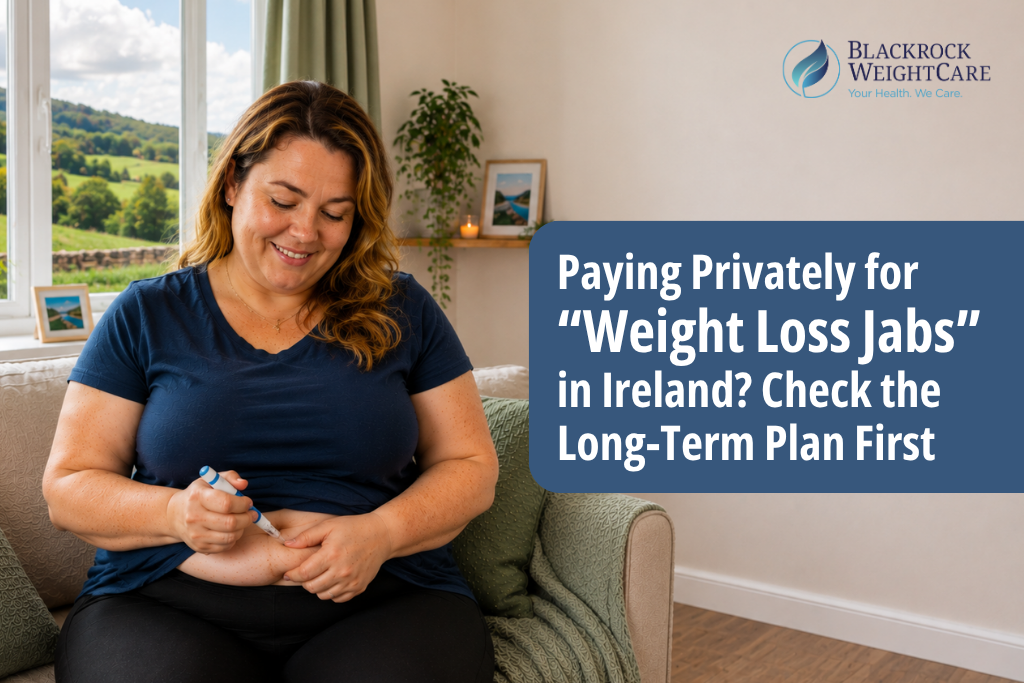
Weight loss injections such as Mounjaro, Wegovy and Ozempic have changed the conversation around obesity treatment.
More people than ever are seeking help for their weight, and that’s a positive step. These medications have helped many people lose a meaningful amount of weight, improve their health and take control of conditions such as Type 2 diabetes.
As a result, thousands of people across Ireland are now paying privately for these medications every month.
Before starting treatment, however, there’s one important question that’s often overlooked.
What’s the long-term plan?
It’s easy to focus on the first prescription or the first few months of weight loss. What’s equally important is understanding what happens a year from now, two years from now or even five years from now.
At Blackrock WeightCare, we believe every obesity treatment plan should look beyond the first few kilograms of weight loss. Whether that plan involves medication, bariatric surgery or both, the goal should always be long-term health.
Weight Loss Medications Are Changing Lives
There’s no doubt that GLP-1 medications have transformed obesity care.
For many people, they reduce appetite, improve feelings of fullness and make it easier to adopt healthier eating habits. They can also improve blood sugar control and reduce the risk of obesity-related health complications.
This is why they have become an important treatment option for many patients living with overweight and obesity.
The growing interest in these medications also reflects something positive – people are increasingly recognising that obesity is a medical condition deserving of treatment rather than something that should simply be managed through willpower alone.
The Conversation Shouldn’t Stop at the Prescription
Starting a weight loss medication is one decision.
Planning what happens afterwards is another.
One of the questions we often encourage people to ask is:
“How long am I expected to stay on this medication?”
For some people, long-term treatment may be entirely appropriate.
Others may stop because of side effects, cost, supply issues or personal preference.
Some achieve good weight loss initially but later find their progress slows or their weight begins to increase again after stopping treatment.
These aren’t reasons to avoid medication.
They’re reasons to make sure there’s a longer-term strategy in place from the beginning.
Paying Privately Can Become a Significant Long-Term Commitment
Many people in Ireland currently pay privately for weight loss injections because access through public services or health insurance may be limited.
While the monthly cost may feel manageable at first, obesity is a chronic condition.
Treatment often needs to be considered over years rather than months.
Before committing to ongoing private prescriptions, it’s worth asking yourself:
- What is my long-term treatment plan?
- If I stop the medication, how will my weight be managed?
- What support will I have to maintain my progress?
- Are there other treatment options I should understand?
These conversations are just as important as deciding whether to start medication in the first place.
Medications and Bariatric Surgery Are Not Competing Treatments
One of the biggest misconceptions in obesity care is that patients have to choose between weight loss injections and bariatric surgery.
In reality, they are different treatments with different roles.
For some people, medications provide exactly the support they need.
For others, particularly those living with severe obesity or obesity-related health conditions, bariatric surgery may offer the most effective long-term treatment.
There are also patients who benefit from both.
Weight loss medications may be used before surgery to optimise health, after surgery to help manage weight regain in selected cases, or as part of an individual treatment plan where clinically appropriate.
The important point is that treatment should be personalised rather than viewed as an either-or decision.
If Your BMI Is 35 or Above, It’s Worth Understanding All Your Options
Weight loss medications have expanded the treatment choices available for obesity, but they haven’t replaced bariatric surgery.
If your BMI is 35 or above, particularly if you’re living with conditions such as Type 2 diabetes, sleep apnoea or high blood pressure, it’s worth understanding the full range of treatment options before making a long-term decision.
Bariatric surgery remains one of the most effective treatments for severe obesity and has decades of evidence supporting its role in achieving significant, sustained weight loss and improving obesity-related health conditions.
That doesn’t mean surgery is the right choice for everyone.
It does mean it deserves to be part of the conversation.
The Best Treatment Is the One That Fits Your Life
No two people living with obesity have the same journey.
Some have been trying to lose weight for five years.
Others have been living with obesity since childhood.
Some are looking to improve diabetes control, while others simply want to be able to move more comfortably and enjoy everyday life again.
The best treatment plan takes all of these factors into account.
It considers your health, your medical history, your previous weight loss attempts, your lifestyle and your long-term goals.
Most importantly, it looks beyond what happens over the next few months and focuses on what is likely to help you maintain better health for years to come.
Looking Beyond the Next Prescription
Whether you’re already taking Mounjaro, Wegovy or Ozempic, or you’re considering starting one of these medications, it’s worth taking a step back and thinking about the bigger picture.
Obesity is a long-term medical condition, and successful treatment is rarely about a single prescription or a single procedure. It’s about finding an approach that is sustainable, evidence-based and tailored to your individual health needs.
At Blackrock WeightCare, we help patients understand all of the treatment options available for obesity, including gastric sleeve surgery, gastric bypass and SADI-S. Every patient is assessed individually, and treatment recommendations are based on what is most appropriate for their health, circumstances and long-term wellbeing – not a one-size-fits-all approach.
Choosing treatment for obesity is about more than deciding whether to start a medication. It’s about finding an approach that is right for you in the long term. If you’re paying privately for weight loss injections, or thinking about doing so, and your BMI is 35 or above, it’s worth exploring all of the treatment options available before making that commitment. Understanding your options today can help you make a more informed decision about your health for years to come.
To arrange a consultation with the team at Blackrock WeightCare, complete our enquiry form here or call 01 255 2479.
Your Health. We Care.