
Gastric bypass surgery can be life-changing. Many patients lose a significant amount of weight and see real improvements in conditions such as type 2 diabetes, sleep apnoea and high blood pressure.
But for some people, things can change again years later.
They may notice that the weight starts creeping back. They don’t feel as full as they once did. Meals that used to satisfy them suddenly seem too small. Some patients also begin experiencing unpleasant symptoms of dumping syndrome.
It can be confusing and upsetting. Many people wonder if they have somehow caused the problem themselves.
Often, that isn’t the case at all.
In many situations, the reason is anatomical. The body changes over time, even after successful surgery.
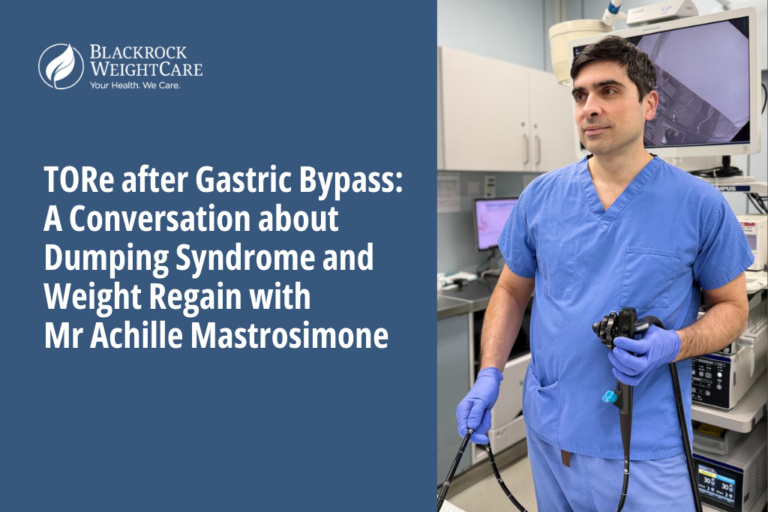
To help explain what happens and what options may exist, we spoke with Mr Achille Mastrosimone, Consultant General and Upper GI Surgeon, who specialises in advanced endoscopic treatments for bariatric patients.
Interview with Mr Achille Mastrosimone
What is TORe?
Mr Mastrosimone: TORe stands for Transoral Outlet Reduction. It is an incisionless endoscopic procedure designed for patients who previously had a Roux-en-Y gastric bypass and later develop problems such as dumping syndrome or weight regain.
The procedure is performed using a flexible endoscope that is passed through the mouth, so there are no external cuts or abdominal incisions.
After gastric bypass surgery, the stomach pouch connects to the small intestine through a small opening called the gastrojejunal anastomosis, often referred to as the outlet.
Over time this outlet can stretch. When that happens, food moves through the stomach more quickly and the feeling of fullness becomes weaker.
During TORe, we place sutures around this outlet using a specialised endoscopic suturing device. This reduces its size again, which helps slow gastric emptying and restore restriction.
In some cases, if the gastric pouch has also stretched, we can reduce its size endoscopically at the same time.
Why does gastric bypass sometimes stop working as well over time?
Mr Mastrosimone: Weight regain after gastric bypass is usually multifactorial. There are often several contributing factors, including physiological adaptations, behavioural changes, and, in some patients, significant anatomical changes.
In some patients, over time, the outlet between the stomach pouch and the small intestine can widen, and the pouch itself may stretch slightly. When that happens, the restrictive effect of the operation becomes less effective.
As a result, food can pass through the pouch more quickly, patients may feel hungry again sooner after eating, and portion sizes may gradually increase. This can contribute to weight regain.
It is important to stress that these changes can be mechanical and are not simply a question of behaviour. They may occur even when a patient is doing everything right.
Is dumping syndrome one of the main reasons people consider TORe?
Mr Mastrosimone: Yes, very often. In fact, in my experience the strongest indication for TORe is dumping syndrome.
Dumping syndrome occurs when food moves too quickly from the stomach pouch into the small intestine. Patients may experience symptoms such as sweating, dizziness, nausea, palpitations, diarrhoea or low blood sugar after eating.
By reducing the diameter of the outlet, TORe slows gastric emptying. This can significantly improve these symptoms and help patients feel more comfortable after meals.
How do you decide if someone is suitable for the procedure?
Mr Mastrosimone: The first step is a careful assessment of the anatomy. Before recommending TORe, I perform an OGD, also known as a gastroscopy. This is a procedure that uses a small camera to look inside the stomach. It allows me to measure the opening and assess the size and length of the stomach pouch.
This evaluation is essential because TORe works best when the outlet is enlarged. Patients with an outlet diameter of 2.5 cm or more tend to benefit the most, and results are often even better when the outlet is greater than 3 cm.
If the pouch is also significantly enlarged, we may perform an endoscopic pouch revision at the same time as the outlet reduction.
This ensures that the procedure is tailored to each patient’s anatomy.
What happens during the procedure itself?
Mr Mastrosimone: The procedure takes place in theatre under general anaesthetic, which means the patient will be asleep throughout. The anaesthetist will give the anaesthetic and monitor the patient carefully.
We start by performing an OGD (gastroscopy) to reassess the size and length of the stomach pouch. If appropriate to proceed, we then treat the inner lining of the join between the stomach and bowel (the anastomosis) using a special heat probe called APC.
After this, a specialised stitching device attached to the endoscope is used to place stitches around the outlet. These stitches make the opening smaller, which helps food stay in the stomach pouch for longer and move through more slowly.
The procedure usually takes about 60 to 90 minutes.
As there are no cuts on the outside of the body, recovery is usually quicker than with revisional surgery.
How does TORe compare with revisional bariatric surgery?
Mr Mastrosimone: Revisional surgery can be quite complex. Surgeons often have to deal with scar tissue and may need to reconstruct parts of the bypass.
TORe is much less invasive because it’s done endoscopically. There are no abdominal incisions, and the recovery is usually faster. The risk of complications is also generally lower.
For some patients, TORe can delay or even avoid the need for major revisional surgery.
What should patients expect after the procedure?
Mr Mastrosimone: Most people recover well after the procedure and only have mild symptoms. It is quite common to have a sore throat or some temporary bloating. Mild abdominal discomfort can also occur, but this is usually well controlled with common painkillers.
Many patients go home the same day or after a short overnight stay.
Normal activities can usually be resumed within a few days.
As with any bariatric treatment, the best results happen when the procedure is combined with ongoing dietary and multidisciplinary support.
Understanding the Next Step
Weight regain after gastric bypass can feel discouraging, but it is not unusual. Obesity is a chronic condition, and treatment sometimes needs to evolve over time.
For patients who develop dumping syndrome, loss of restriction or anatomical changes after gastric bypass, TORe may offer a minimally invasive way to address the underlying issue.
At Blackrock WeightCare, careful assessment is always the first step. A detailed consultation and endoscopic evaluation help determine whether TORe is the right option for each individual patient.
If you have had gastric bypass surgery and are experiencing weight regain or dumping syndrome, you can make an enquiry here or call 01 255 2479 to arrange an assessment with the team at Blackrock WeightCare.
Your Health. We Care.