The Question That Matters Most
Many patients considering weight loss surgery in Ireland focus, understandably, on what happens in the first year. The weight loss is rapid, the changes are visible, and the impact on energy and health is often transformative. But the question I always want patients to think about is a longer one: what does this look like in ten years?
https://blackrockweightcare.ie/weight-loss-surgery-dublinThe answer, based on decades of high-quality evidence, is one of the most compelling stories in modern medicine. Bariatric surgery is not just about weight. It is about adding years to your life, reducing your risk of cardiovascular disease, cancer, and diabetes, and sustaining those benefits for the long term — not for months, but for decades.
Here is what the evidence actually shows.
The Big Picture: What 20 Years of Data Tells Us
The most authoritative long-term evidence comes from the Swedish Obese Subjects (SOS) study — a landmark prospective study that enrolled over 4,000 patients with obesity from 1987 to 2001 and followed them for up to 20 years. It remains the most comprehensive long-term investigation of bariatric surgery ever conducted.
Evidence · New England Journal of Medicine, 2020 — SOS Study
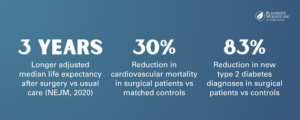
The SOS study found that, over 20 years of follow-up, patients who had bariatric surgery had an adjusted median life expectancy approximately 3 years longer than matched controls receiving usual obesity care. The hazard ratio for overall mortality was 0.77 — a 23% reduction. Cardiovascular mortality was reduced by 30%. The 90-day postoperative mortality in the surgical group was 0.2%.
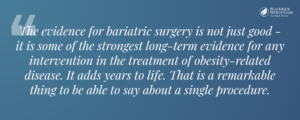
These are not small improvements. A 3-year gain in life expectancy from a single intervention is a result that rivals many of the most celebrated treatments in cardiovascular medicine. And unlike medication, the effect does not stop when you stop taking something – because there is nothing to stop taking.
Year by Year: What to Expect
Year 1 — Rapid Transformation
The first year typically sees the most dramatic change. Most patients experience their fastest rate of weight loss in months 1–12.
- Average total body weight loss of 25–35% in the first year depending on procedure
- Type 2 diabetes improves or resolves — often within weeks of surgery, before major weight loss
- Blood pressure, sleep apnoea and joint pain typically improve significantly
- Energy levels, mobility and quality of life improve substantially
Years 2–5 — Consolidation
Weight loss typically slows and stabilises after the first 12–18 months. Some degree of weight regain is normal and expected in most patients — this does not represent failure.
- SOS study: mean weight loss of 23% at 2 years, stabilising to approximately 17% at 10 years
- Comorbidity resolution sustained — diabetes remission maintained in the majority
- The SLEEVEPASS trial (JAMA Surgery, 2022) confirmed sustainable weight loss for both sleeve and bypass at 10 years
- Cardiovascular risk factors continue to improve relative to non-surgical controls
Years 5–10 — Long-Term Durability
The defining period for durability. This is where bariatric surgery’s advantage over medication becomes most stark — medically-managed weight loss almost universally returns without ongoing treatment. Surgically-achieved weight loss largely persists.
- A systematic review and meta-analysis (O’Brien et al., Obesity Surgery, 2019) covering 57 datasets found all major bariatric procedures associated with durable weight loss at 10+ years
- Greater than 50% excess weight loss maintained for all current procedures at 10 years in the meta-analysis
- Mortality benefit becomes clearly established — SOS data shows advantage emerging over 10–13 years of follow-up
- Reduced incidence of myocardial infarction (adjusted HR 0.71) and stroke (adjusted HR 0.66) vs controls
15 Years and Beyond
The most compelling long-term data. Very few medical interventions for chronic disease can show benefits at this timeframe.
- SOS study: mean weight change of −16% at 15 years and −18% at 20 years in surgical group; essentially 0% in controls
- Cancer incidence reduced by 42% in women in the surgical group in the SOS study (men: no statistically significant difference)
- Life expectancy benefit sustained across all follow-up periods studied
- Patients with diabetes who achieved remission showed further reduction in long-term mortality risk
What About Weight Regain?
This is a question I encourage every patient to raise — because it deserves an honest answer. Some degree of weight regain after bariatric surgery is common and well-documented. It does not mean the surgery has failed, and it does not erase the benefits.
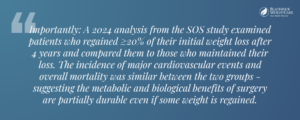
The SOS study data shows that even accounting for partial weight regain over time, surgical patients maintained substantially greater weight loss than non-surgical controls at every time point measured — 2, 10, 15 and 20 years. The cardiovascular and mortality benefits persisted regardless of the degree of regain.
Where significant weight regain does occur, we now have additional tools — including GLP-1 medication used as an adjunct — to help patients get back on track. This is part of what makes a comprehensive aftercare programme so important.
Beyond Weight: The Broader Health Benefits
Framing bariatric surgery purely as a weight loss procedure understates what it does. The most profound effects are often on conditions that carry the greatest health risk:
SOS Study · Summary of Key Outcomes at 10–20 Years
Type 2 diabetes: 83% reduction in new diagnoses; significant remission in those already diagnosed. Myocardial infarction: adjusted HR 0.71 (29% reduction). Stroke: adjusted HR 0.66 (34% reduction). Cancer (women): adjusted HR 0.58 (42% reduction). Overall mortality: adjusted HR 0.71–0.77 across follow-up periods. These outcomes are from published, peer-reviewed data in the New England Journal of Medicine and Journal of Internal Medicine.
These are not surrogate markers. These are deaths prevented, heart attacks avoided, and cancers that did not develop. The surgery that patients often fear most turns out to be one of the most powerful protective interventions available to people living with severe obesity.
Your Health. We Care.